




Nawabs CafeReview:
By ANR Writing
Rating: 2.25/5
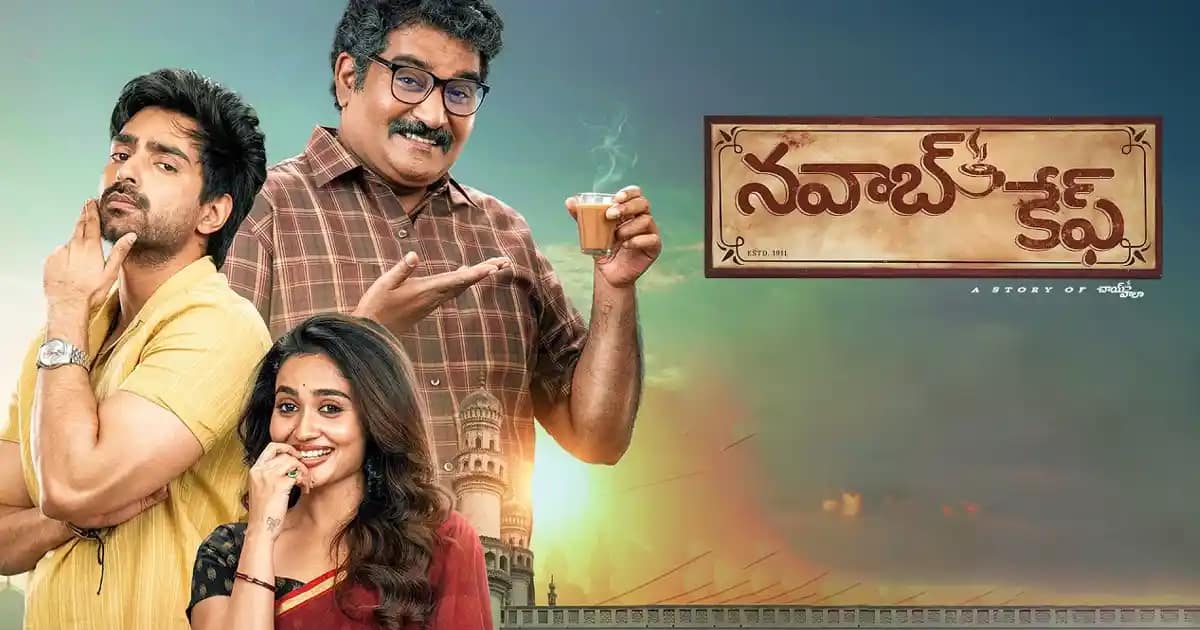
After a delay due to title-related issues, Nawabs Cafe finally arrives in theatres on February 20. Starring Shiva Kandukuri in the lead and directed by Pramod Harsha, the film attempts to blend emotion with a simple, rooted premise. The big question, however, is whether this emotional drama manages to deliver a commercial breakthrough for its young hero.
Story:
At the heart of Nawabs Cafe lies a generational conflict.
Raja (Shiva Kandukuri) is embarrassed by his family’s ancestral business the iconic Nawab Cafe which is lovingly run by his father Ranganath (Rajeev Kanakala). Raja despises being referred to as a “chaiwala” and wants to distance himself from the traditional identity tied to the café.
Circumstances, however, force him to take charge of the very business he resents.
Why does he reluctantly accept this responsibility? What transformation does he undergo? Can he match his father’s legacy and successfully run the café? These questions form the emotional backbone of the narrative.
Performances:
Shiva Kandukuri delivers a passable performance, particularly in emotional sequences. While his screen presence is adequate, there remains visible scope for growth in terms of maturity and depth as a performer. The arc demands a stronger internal transition, which only partially translates on screen.
Teju Ashwini makes a neat impression despite limited screen time. She adds grace to her character and manages to leave a mark with expressive body language and subtle emoting.
Rajeev Kanakala, as the father, attempts to bring gravitas to his role. However, the character itself lacks proper establishment and emotional layering. As a result, the intended father-son emotional resonance never fully lands.
Chaitanya Krishna, appearing in a negative-shaded role, is serviceable. Yet, the character arc remains underdeveloped, reducing the impact of his presence in the conflict.
Technical Aspects:
The film’s strongest pillar is its music. Composer Prashanth R. Vihari delivers soulful songs and an effective background score that elevate several otherwise flat moments. His work stands out as the most consistent technical contribution.
However, the sound mixing is noticeably uneven. Dialogues are unclear in several sequences, and some portions sound like unpolished live recordings. This technical lapse significantly affects immersion.
Editing lacks sharpness, with continuity errors cropping up in multiple scenes. The narrative flow feels uneven, and tighter trimming could have improved engagement.
Director Pramod Harsha deserves credit for selecting a concept rooted in tradition and emotional identity. Unfortunately, the execution falls short. The screenplay lacks compelling dramatic highs, and the emotional payoffs feel underwritten. Moreover, the thematic resemblance to films like Idli Kottu and Miss India makes the narrative feel familiar rather than fresh.
Analysis:
Inspiration-driven stories demand novelty in both character design and narrative treatment. While Nawabs Cafe begins with a promising premise about legacy, dignity of labour, and generational reconciliation, it struggles due to weak emotional elevation and technical inconsistencies.
With a stronger screenplay, refined character arcs, and better sound design, the film could have resonated more effectively. Instead, it settles for a predictable and emotionally muted experience.
Verdict:
Nawabs Cafe has a relatable core but falters in execution. A few heartfelt moments and commendable music cannot compensate for its narrative and technical shortcomings.
A mildly watchable emotional drama that needed stronger brewing to truly leave a flavour.